
Every wholesale wig quotation carries a three-letter code that determines who pays for freight, who carries the risk while the cartons cross the ocean, and whose problem it is when customs holds a shipment. Most first-time importers accept whatever term the supplier defaults to, then discover the cost of that decision on the freight invoice. In our wholesale operation, the same catalog SKU is quoted on different terms every week, and the landed cost difference between FOB and DDP on an identical order routinely runs 15 to 25 percent. Understanding Incoterms 2020 is a procurement skill, and for wig buyers it comes with one category-specific complication: wigs are lightweight, bulky cargo, so freight is usually billed on volume rather than scale weight.
The short answer for buyers. Four terms cover nearly every wig shipment leaving China: EXW (buyer arranges everything from the factory door), FOB (supplier delivers to the vessel at the origin port, buyer owns the main freight), CIF (supplier pays freight and minimum insurance to the destination port, but risk still transfers at origin), and DDP (supplier delivers to your door, duties included). New importers and marketplace sellers should start on DDP for landed-cost certainty. Established buyers with a freight forwarder and consolidation volume pay less on FOB.
The Four Terms That Cover the Wig Trade
Incoterms 2020 defines eleven rules, but wig buyers will realistically negotiate four of them. The table below fixes the two points that matter in every quote: where risk transfers from seller to buyer, and who pays each cost element.
| Term | Risk Transfers to Buyer | Main Freight Paid By | Import Duty Paid By | Best Suited For |
|---|---|---|---|---|
| EXW (Ex Works) | At the factory door | Buyer | Buyer | Buyers with their own China-side agent or forwarder |
| FOB (Free On Board) | Once goods are on board the vessel | Buyer | Buyer | Established importers consolidating volume |
| CIF (Cost, Insurance, Freight) | Once goods are on board the vessel | Seller | Buyer | Buyers wanting freight arranged but keeping customs control |
| DDP (Delivered Duty Paid) | At the buyer's named address | Seller | Seller | First-time importers, marketplace and DTC sellers |
Two boundary rules prevent most disputes. FOB, CIF, and the other F- and C-group sea terms apply to ocean freight only; for air shipments the any-mode equivalents (FCA, CPT, CIP) govern. And DDP is the only term under which the seller pays import clearance and duties. Every other term leaves customs to the buyer.
Why Wigs Are Billed on Volume, Not Weight
Freight pricing runs on chargeable weight: the higher of actual gross weight and volumetric weight. The IATA formula for air freight converts carton dimensions to kilograms by multiplying length, width, and height in centimeters and dividing by 6,000, which encodes a density threshold of 167 kg per cubic meter. Cargo denser than that threshold bills by the scale; cargo lighter bills by the space it occupies. Express couriers apply a stricter divisor of 5,000.
A worked example shows why this matters for wigs. Take a master carton of 60 x 45 x 50 cm holding 40 long curly units at a combined 14 kg. Volumetric weight by air is 60 x 45 x 50 / 6,000 = 22.5 kg, so the airline bills 22.5 kg against a 14 kg scale reading, a 60 percent premium. The same carton by express bills at 27 kg. By sea, LCL cargo is rated on a weight-or-measure rule where one cubic meter equals one revenue ton, so the carton bills by its 0.135 CBM regardless of how little it weighs. High-density straight units compress well and drift toward actual-weight billing; voluminous afro and curly builds are pure volumetric cargo. This is why specification choices upstream, including wig density and packaging compression, move the freight line on your landed cost before a single box ships.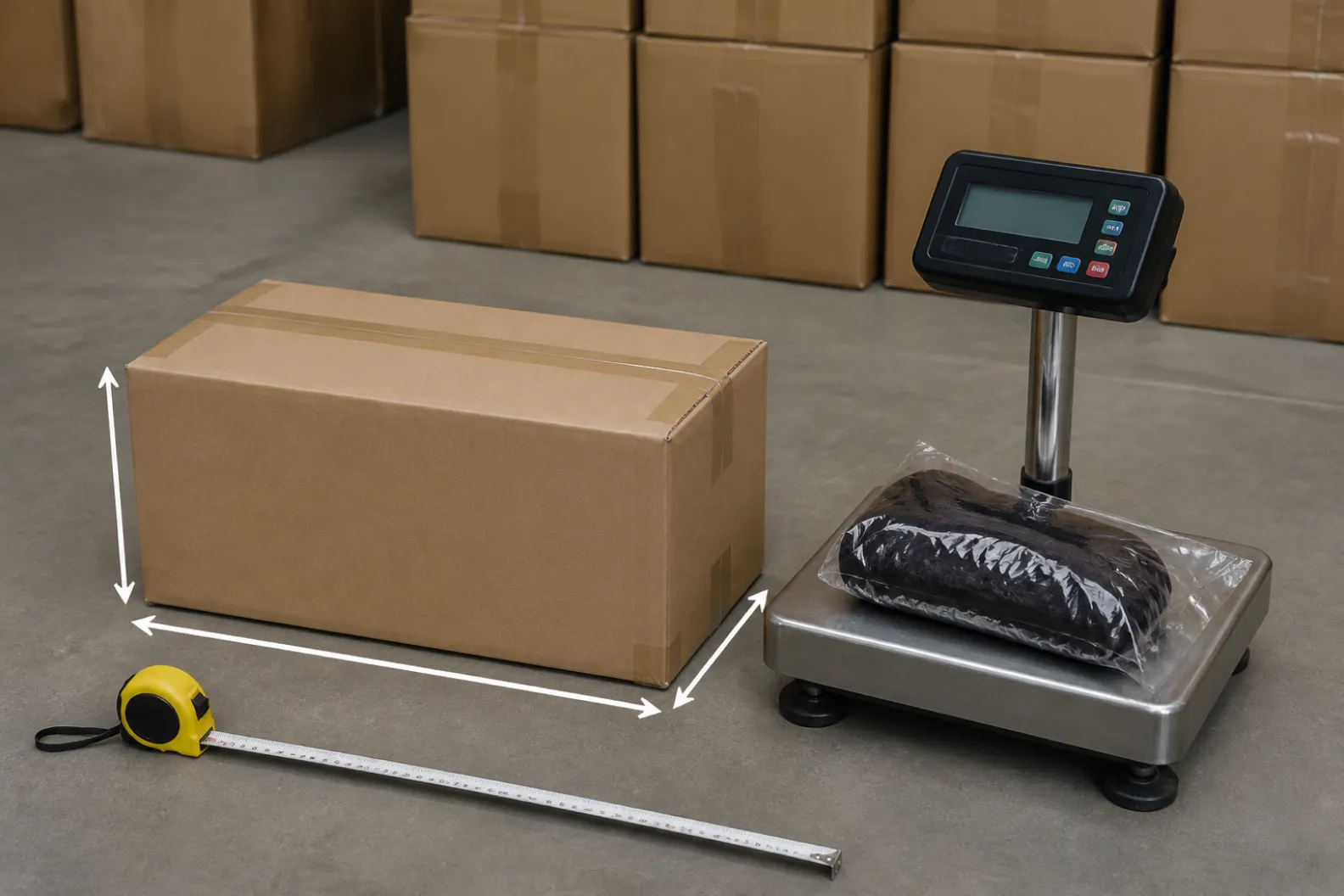
FOB: The Baseline Term for Established Importers
Under FOB, the supplier's obligation ends when the cargo crosses onto the vessel at the named origin port. We quote FOB Ningbo or FOB Shanghai as standard because both ports sit within normal trucking distance of our Zhejiang facility, keeping origin charges predictable. The buyer books the ocean leg, chooses the carrier and sailing, and controls the freight spend. For buyers shipping multiple containers a year or consolidating wig orders with other goods at a 3PL, FOB is almost always the cheaper structure, because supplier-arranged freight carries a margin that a good forwarder will beat.
The discipline FOB demands is insurance and timing. Risk transfers at the origin port even though you are paying the freight, so marine cargo insurance is the buyer's responsibility from the moment the container loads. A bill of lading, commercial invoice, and packing list pass to your broker, and from there the shipment is your operation. Buyers who cannot name their forwarder when they send a purchase order should not be buying FOB.
CIF: The Term Buyers Misread Most Often
CIF looks like the seller taking responsibility for the ocean crossing, since the seller pays freight and insurance to the destination port. The legal reality is narrower: risk still transfers to the buyer when the goods load at origin, and the insurance the seller must provide is minimum cover, Institute Cargo Clauses (C), which excludes most of the losses that actually occur in container shipping. If a CIF container of wigs arrives water-damaged, the claim runs through a minimum-cover policy arranged by your counterparty, in their name structure, under terms you did not negotiate.
CIF earns its place in one scenario: a buyer who wants freight handled but insists on controlling import clearance, typically because they hold their own customs bonds or claim duty drawbacks. Everyone else should read CIF quotes with the transfer point in mind and either upgrade the insurance in writing or price the risk.
DDP: Landed Cost Certainty for New and Scaling Sellers
DDP collapses the entire chain into one number: the supplier delivers to your named address with export clearance, freight, import clearance, duties, and taxes included. For a first-time wig importer, DDP converts an intimidating sequence of forwarders, brokers, and duty payments into a single invoice line, which is why we offer DDP to the US, UK, EU, Australia, and Canada as a standard option on wholesale orders. Wigs classify under HTS heading 6704, and the duty outcome depends on fiber type and origin treatment; our 2026 North America tariff briefing tracks the current position for US-bound shipments.
Two checks protect a DDP buyer. First, require the quote to state exactly what the delivered price includes, because a loosely written DDP offer can exclude duty, brokerage, or remote-area delivery surcharges that surface later as collect charges. Second, confirm who is the importer of record, since that party carries the compliance liability. A supplier that answers both questions in writing, with the HTS code on the commercial invoice, is running a real DDP program rather than reselling a courier account.
Matching the Term to the Order Profile
Sample shipments and urgent replenishment move by express courier regardless of the named term, and the freight math above explains why keeping sample cartons compact saves real money. A first bulk order belongs on DDP: the landed cost is fixed before you commit, and the cash-flow math from our supplier vetting guide applies unchanged. From the second or third order onward, buyers with a forwarder relationship should request the same quote on both FOB and DDP and compare the delta. When the DDP premium narrows below roughly 10 percent of the FOB-based landed estimate, the simplicity usually wins; when it widens past 20 percent, your own freight program is paying for itself. EXW only makes sense for buyers with China-side representation, since it leaves export clearance, origin trucking, and port handling in your hands.
Shipping Documents Every Wig Order Needs
Whichever term you buy on, the document stack stays constant. The commercial invoice must carry the correct HTS 6704 classification, fiber composition, and declared value. The packing list must match carton counts and gross weights exactly, because customs exams target mismatches first. The bill of lading or air waybill is your title and tracking document. A certificate of origin supports any preferential duty claim, and for synthetic units an OEKO-TEX Standard 100 certificate answers the chemical-safety questions that EU and marketplace compliance teams now ask routinely. Our export desk issues the full set per shipment, including for buyers on custom OEM programs where private-label packaging adds label and barcode documentation to the file.
Plan Your Next Shipment With Raysman
Raysman ships wholesale synthetic wig orders on FOB Ningbo and Shanghai as standard, with DDP available for US, UK, EU, AU, and CA destinations and full export documentation included per shipment. Send your SKU list, quantities, and destination port or postcode through the wholesale page, and the quote you receive within 24 hours will state the term, the transfer point, and the chargeable-weight basis, so the landed cost you plan against is the landed cost you pay.
-

Raysman
Synthetic Wig Manufacturer
Raysman is a Zhejiang-based synthetic wig manufacturer specializing in party, costume, and fashion color wigs — producing over one million pieces a year from our 10,000 m² Longyou facility. We are BSCI, ISO 9001, and OEKO-TEX Standard 100 certified, and a designated supplier to Disney and Walmart.